10 Wild Plants You Can Find in Your Backyard
Foraging is usually imagined as a hike into deep wilderness. In practice, the most productive patch most people have access to is the one they mow every weekend.
Why the Backyard Is the Best Place to Start
A lawn, a garden bed, and a strip of pavement edge together contain an astonishing amount of edible plant life. There are real advantages to learning here rather than in the backcountry: you can visit the same plants daily and watch them change through the season, you know exactly what has and has not been sprayed, and you can practise identification with zero pressure.
One caution before the list. A backyard is only a clean harvest if you know its history. Avoid anything growing where herbicides or pesticides have been applied, near treated timber, along roadsides, or anywhere dogs regularly go. If you rent or have recently moved, ask before you pick.
1. Lamb's Quarters (Chenopodium album)
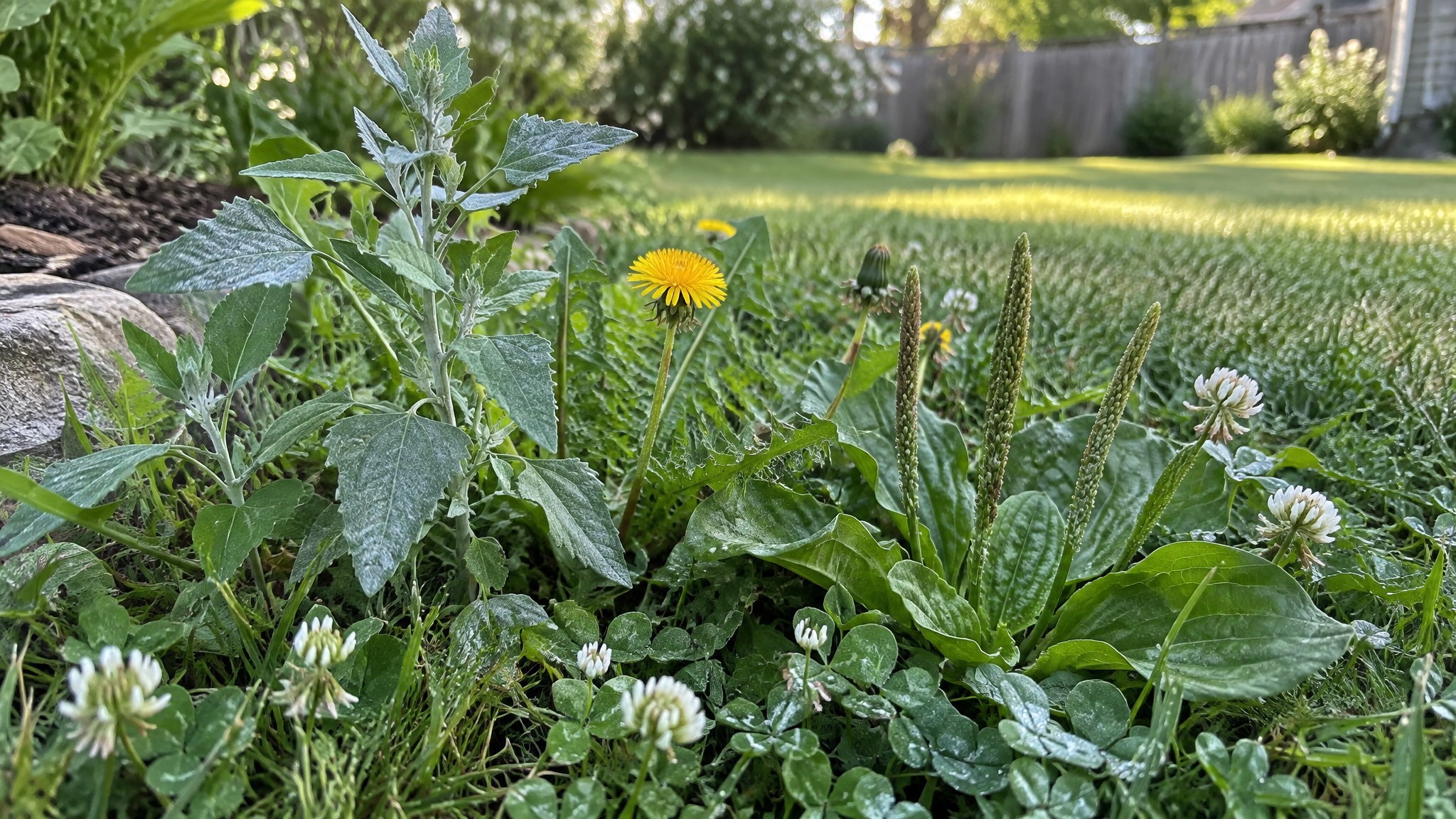
The best of the bunch, and the one worth learning first. Look for the mealy, flour-like white coating on diamond-shaped leaves with wavy toothed edges. It appears in garden beds, vegetable patches, compost heaps, and cracks in the pavement from spring onward. Young plants under a foot tall are the most tender, and they taste like a mild, slightly earthy spinach. Our identification guide covers every growth stage.
2. Dandelion (Taraxacum officinale)
Every part is usable — leaves, buds, flowers, and root. The leaves grow in a flat rosette of deeply toothed lobes with a hollow stem and milky sap. Spring leaves are mild and good raw; summer leaves turn bitter and want cooking. The flowers make an excellent fritter or syrup, and the root can be roasted as a coffee substitute.
3. Broadleaf Plantain (Plantago major)
A flat rosette of broad, strongly ribbed leaves growing in compacted soil — lawn edges, paths, driveway cracks. The parallel veins running the full length of each leaf are the giveaway. It is too fibrous to eat raw, but chopped and cooked it works in soups and stews, and it is a classic traditional poultice for insect bites and minor scrapes.
4. White Clover (Trifolium repens)
The three-lobed leaves and white flower heads are unmistakable, and it is one of the most common lawn plants in the world. The flowers are the best part — sweet, and good raw in salads or steeped for a light tea. Leaves are edible too, though best when young. Do not confuse it with the unrelated and toxic Oxalis species, which have heart-shaped leaves rather than oval leaflets.
5. Chickweed (Stellaria media)
A sprawling, delicate plant with small oval leaves and tiny white star flowers, thriving in cool, moist, shaded corners. The definitive test is the single line of fine hairs running down one side of the stem, switching sides at each leaf pair. Mild, slightly sweet, and excellent raw. It vanishes once the heat arrives, so spring is your window.
6. Wood Sorrel (Oxalis stricta)
Often mistaken for clover, wood sorrel has distinctive heart-shaped, folded leaflets in groups of three and small yellow flowers. It has a bright, tart, lemony flavour from oxalic acid. A little goes a long way — it is a garnish and a flavour accent, not a bulk green, and should be eaten in small quantities.
7. Purslane (Portulaca oleracea)
A low, sprawling succulent with thick reddish stems and small fleshy paddle-shaped leaves, appearing in midsummer in warm, dry, disturbed ground. It is notably rich in omega-3 fatty acids for a vegetable. The texture is crisp and juicy, with a slightly sour, peppery taste. Excellent raw in salads or lightly pickled.
8. Wild Violet (Viola sororia)
Heart-shaped leaves growing in low clumps in shaded lawn and woodland edge, with the familiar purple flowers in spring. Both leaves and flowers are edible and mild, and the flowers make a striking addition to salads. Note that many cultivated pansies and violas sold in garden centres are grown with systemic pesticides — stick to the volunteers in your own lawn.
9. Curly Dock (Rumex crispus)
A rosette of long, narrow leaves with distinctly wavy, crisped edges and a reddish base, growing from a deep taproot. The leaves are lemony and slightly bitter. They contain oxalic acid, so they are best cooked and eaten in moderation rather than raw in quantity. The mature seeds can be gathered and ground into a flour.
10. Garlic Mustard (Alliaria petiolata)
A biennial with heart- to triangle-shaped, scalloped leaves, common in shaded garden edges and under hedges. Crush a leaf and you will get an unmistakable garlic aroma — that smell is the identification. It is aggressively invasive in North America, so harvesting it is genuinely beneficial. Young leaves are excellent raw or as a pesto.
The Safety Rules That Matter
Ten plants is enough to get into trouble if you are careless, so treat these as non-negotiable.
- Never eat a plant you have not identified with certainty. A confident guess is not an identification.
- Learn the dangerous look-alikes for each plant, not just the plant itself. Our look-alike comparison guide covers the plants most often confused with lamb's quarters, including the genuinely toxic ones.
- Try a small amount first. Individual sensitivities exist even for well-established edible plants.
- Know your soil. No foraging on sprayed ground, near roadsides, or where industrial contamination is possible.
- Cook anything high in oxalates — wood sorrel, curly dock — and eat those in moderation.
If You Would Rather Get Rid of Them
Not everyone wants a lawn full of edible weeds, and that is a completely reasonable position. Several plants on this list — lamb's quarters especially — are prolific self-seeders that can take over a vegetable bed fast. If that is your situation, our lamb's quarters weed control guide covers hand-pulling, mulching, solarization, and chemical options, along with the timing that actually matters.
Or Grow the Good Ones on Purpose
There is a middle path between foraging and weeding: cultivate the plants you actually want. Lamb's quarters in particular is trivially easy to grow deliberately — it self-seeds prolifically, tolerates poor soil, and needs essentially no care once established. Our growing guide covers habitat, hardiness zones, and how to establish a reliable patch, and the seeds guide explains where to source seed and how to save your own.
Start With One Square Metre
Pick a single patch of your yard and learn everything growing in it. Photograph each plant, identify it properly, and check back weekly to watch it change. Within one growing season you will know more about the edible plants around you than most people learn in years of casual interest — and you will have a reliable, free source of greens a few steps from your door.