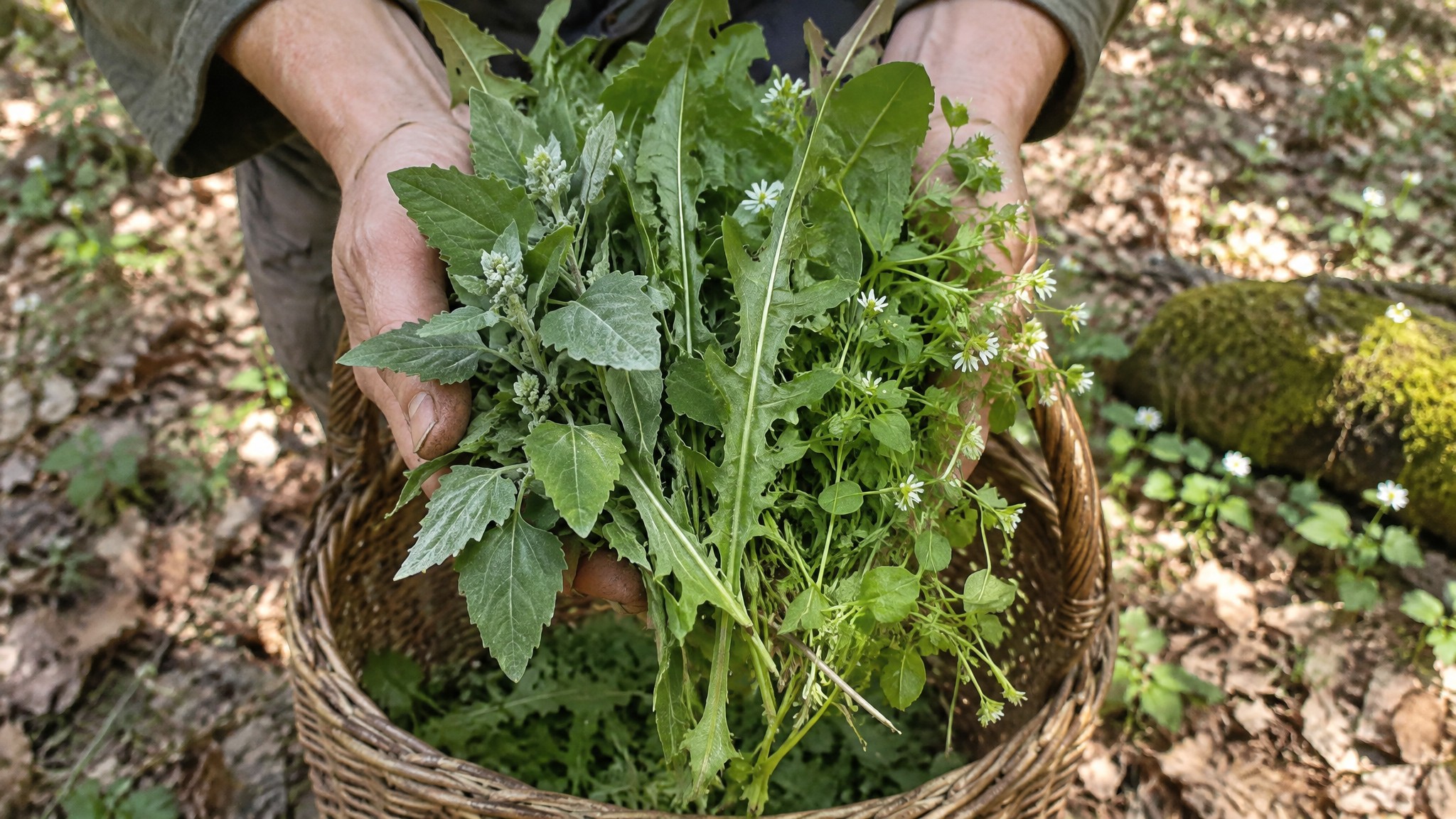
The Forager's Field Guide to Spring Greens
Spring is the forager's best window of the year. Here's how to read the season, find the five greens worth knowing first, and bring them home safely.
Why Spring Is the Best Time to Forage
Every edible wild green has a season, and for most of them spring is it. A plant that is tough, bitter, and stringy in August is tender, sweet, and mild in April. There are three reasons for this, and understanding them makes you a better forager immediately.
- The plant is growing, not reproducing. Before a green bolts into flower, all of its energy goes into leaves and stems. Once it flowers, that energy is redirected into seed and the leaves turn fibrous and bitter.
- Water content is high. Spring rain and cool temperatures keep leaves plump and crisp. That is what makes them good eating.
- Competition is low. In April and May, most other vegetation has not yet leafed out. Edible greens stand out clearly against bare ground and last year's dead stems, which makes identification far easier than in the crowded green wall of July.
The practical rule that follows from all this: harvest before the flowers open. If you see buds forming, you have days, not weeks.
The Five Spring Greens to Learn First
You do not need to know a hundred plants. You need to know five well enough that you could pick them blindfolded. These are the ones that are abundant, genuinely good to eat, and reasonably safe to learn.
1. Lamb's Quarters (Chenopodium album)
The best-tasting wild green in North America, and the most forgiving to identify. Look for the unmistakable mealy, white-grey coating on the leaves — it looks like someone dusted the plant with flour, and no common look-alike has it. The leaves are diamond- or goosefoot-shaped with wavy toothed edges, and they grow alternately up the stem. Young plants under a foot tall are the most tender. It tastes like a mild, slightly earthy spinach and can be used anywhere spinach is called for. Our full lamb's quarters identification guide walks through every growth stage with photos.
2. Dandelion (Taraxacum officinale)
The most recognizable wild green in the world, and far better eating than its reputation suggests. The leaves are deeply toothed and lobed, growing in a flat rosette from a single taproot, with a hollow stem and a milky white sap when broken. Spring leaves are mild; once the plant flowers they turn aggressively bitter. Young leaves are excellent raw in salads, and older ones are best blanched or sautéed to tame the bitterness.
3. Chickweed (Stellaria media)
A low, sprawling plant with small oval leaves and tiny white star-shaped flowers. The reliable identifying trick is the single line of fine hairs running down one side of the stem — it switches sides at each pair of leaves. Chickweed is mild, slightly sweet, and excellent raw. It is at its best in cool weather and disappears in summer heat.
4. Broadleaf Plantain (Plantago major)
Not the banana-like fruit — this is the flat rosette of broad, ribbed leaves growing in lawns and along paths everywhere. The leaves have strong parallel veins running their length and a tough, stringy texture. Too fibrous to eat raw, plantain is best chopped and cooked, and it is a classic traditional poultice plant for insect bites and minor skin irritation.
5. Garlic Mustard (Alliaria petiolata)
An invasive biennial that is genuinely delicious, which makes eating it a public service. The leaves are heart- to triangle-shaped with scalloped edges, and the definitive test is smell: crush a leaf and you get a clear garlic aroma. Young first-year leaves are the best, with a garlicky-mustard bite that works raw in salads or cooked into pesto.
Identify With Certainty, Not Enthusiasm
The single most important skill in foraging is knowing when to walk away. Every one of the greens above has plants that resemble it, and a few of those resemble it closely enough to matter. Before you eat anything you have picked, you should be able to answer three questions about it: what exactly is it, what does it look like when it is not that, and what is the worst thing it could be mistaken for.
For lamb's quarters specifically, the mealy coating does most of the work — but it is still worth knowing the difference between it and pigweed, goosefoot, and the genuinely toxic plants that share its habitat. Our look-alike comparison guide puts them side by side in a table so you can rule them out one by one.
A green you cannot identify with certainty is not food. It is a plant you are holding. Put it down.
How to Harvest Without Damaging the Patch
Spring greens are forgiving, but a few habits keep a patch productive for years rather than one season.
- Take the top, leave the base. Pinch or cut the top four to six inches of growing tips. The plant regrows from below, and you get the tenderest material.
- Never take more than a third of any single plant, and never clear a patch entirely. Leave the strongest plants to set seed.
- Harvest in the morning after dew has dried. Leaves are crispest then and keep longest.
- Avoid roadsides, sprayed lawns, and dog-walking routes. This is not fussiness — it is the difference between a clean harvest and a contaminated one.
- Get them cold fast. Wash in cold water, dry, and refrigerate like spinach. Most spring greens hold three to five days.
Our harvesting and preserving guide covers the full process, including how to blanch and freeze a spring glut so it lasts into winter.
Cooking Your First Spring Harvest
Wild greens behave much like their cultivated cousins, which means you already know how to cook them. Lamb's quarters, chickweed, and young dandelion can all be used raw in salads. Anything tougher — plantain, older dandelion, garlic mustard — wants heat.
The simplest approach that works for every green on this list: heat olive oil, add sliced garlic, wilt the greens for two to three minutes with a pinch of salt, and finish with lemon. That is a side dish, a pasta topping, or a filling for eggs. If you want something more structured, our lamb's quarters recipe collection includes a wild spinach pesto, a spring greens soup, and a raw salad built specifically around young leaves.
A Short Spring Calendar
Timing shifts with your climate, but the sequence is remarkably consistent across temperate regions.
| Window | What Is at Its Best |
|---|---|
| Early spring (first warm weeks) | Chickweed, young dandelion, garlic mustard rosettes |
| Mid spring | Lamb's quarters seedlings and young plants, plantain, violet leaves |
| Late spring | Lamb's quarters at peak, larger dandelion (blanch these) |
| Early summer | Last call — greens bolt, turn bitter, and toughen |
The Forager's Etiquette
A few unwritten rules keep wild food accessible to everyone. Never forage on private land without permission, and never in protected areas where it is prohibited. Do not harvest from the same patch every week — rotate. Leave rare plants alone entirely, no matter how good they look. And learn what is invasive in your region: eating garlic mustard, for instance, is actively helpful.
Start With One Plant
The temptation is to learn everything at once. Resist it. Pick the single green you are most likely to encounter this week — for most people that is lamb's quarters, because it grows in gardens, sidewalk cracks, and disturbed ground almost everywhere — and learn it completely. Once you can spot it from a moving car, add the next one. That is how the knowledge actually sticks.